
When Your Health And Safety Manager Leaves: What Actually Happens Next
Your health and safety manager hands in their notice on a Tuesday morning. By the time you have finished reading the email, you already know the real problem sits somewhere other than recruitment.
Recruitment is the visible task. The harder one is everything that person has been carrying that nobody else in the building can see.
This article covers two things: what actually happens when that knowledge leaves, and how the right support model keeps your business covered, both during the gap and for the long term, so you are never this exposed again.
Our founder, Paul Feely, has spent more than 25 years in health and safety, a good part of it on site before he ever picked up a clipboard. We have watched this situation play out across construction, manufacturing, and retail. It rarely looks like a staffing gap on paper, and that is precisely what makes it costly.
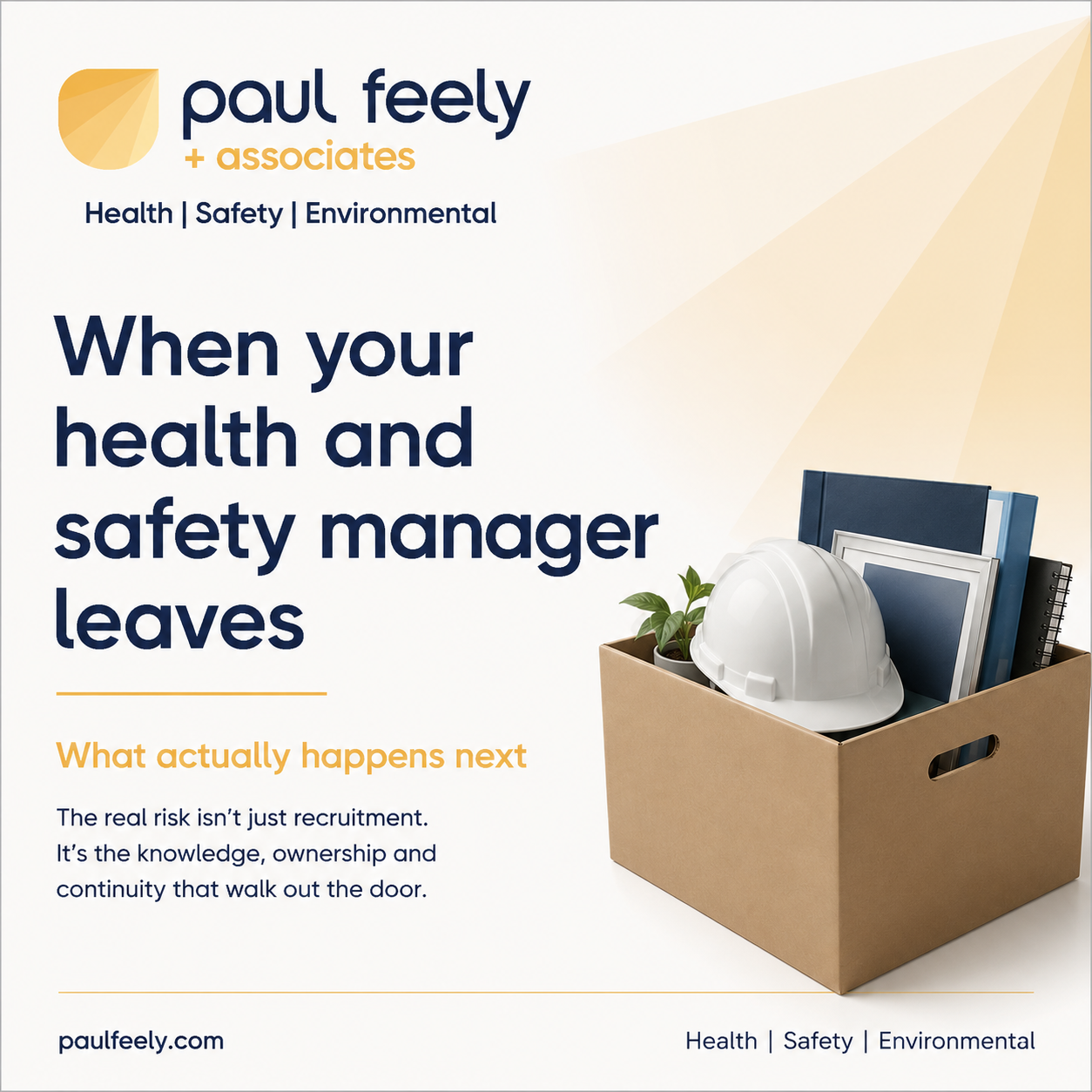
The Knowledge That Walks Out The Door
Most of what a good safety person does never makes it onto a job description. They know which sites are behind on inspections. They know there is an audit due in six weeks with three actions still open from the last one. They can tell you which supervisor cuts corners under pressure and which one to trust with a new starter.
That knowledge lives in one head. When that person leaves, it leaves with them.
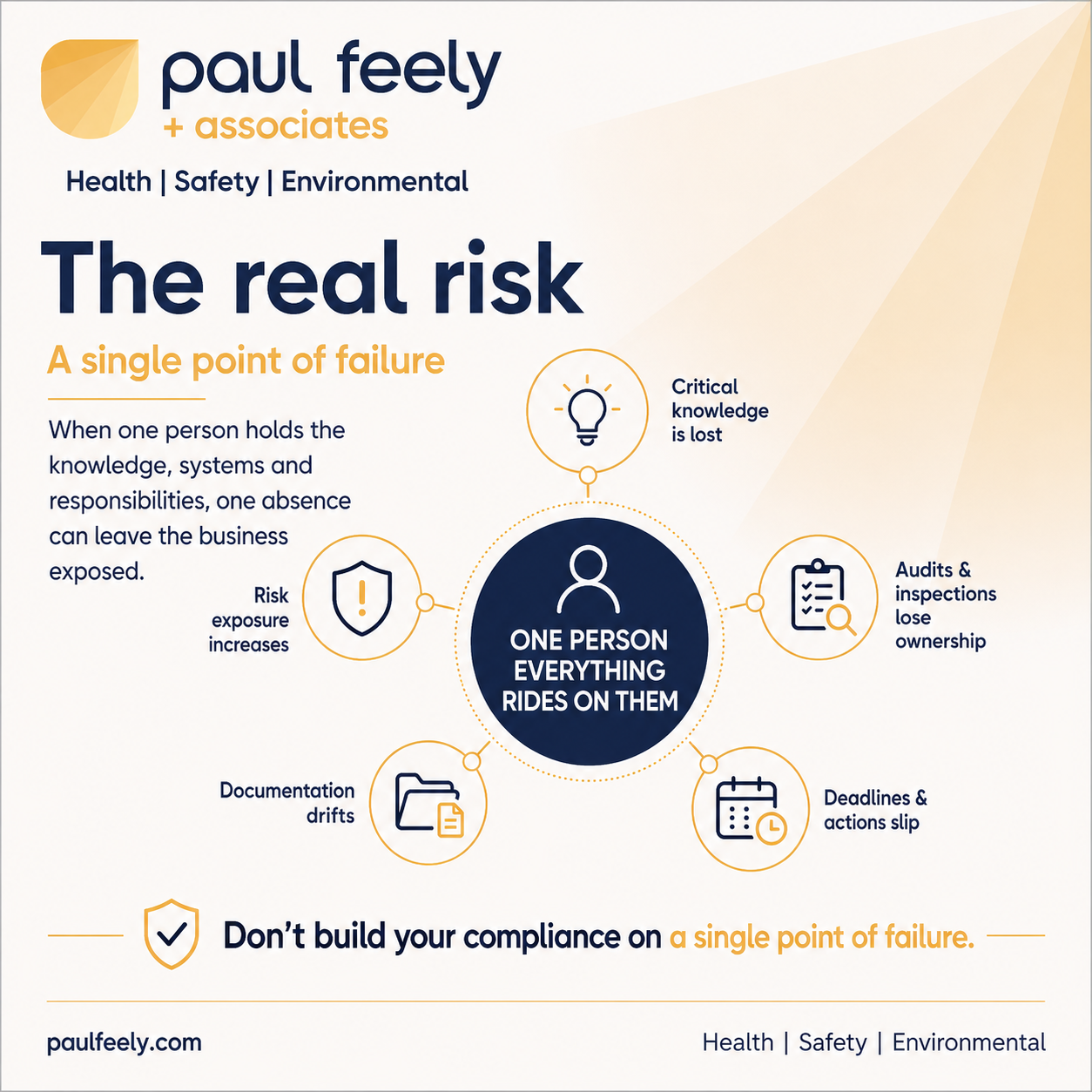
Recruiting a replacement can take months, and the person leaving is often gone before the new one is found. So for a stretch, sometimes a long one, the business runs without the person who understood how it actually worked, site by site. Audits and investigations lose a clear owner. Deadlines that felt handled quietly stop being anyone's job. Improvements that were halfway done stall.
Losing the person is one problem. The larger one is how much depended on them being there at all.
The Risk Of Depending On One Person
Plenty of businesses rely on a single health and safety professional. That works well right up until the moment it doesn't. Illness, annual leave, a resignation, or simply too much work landing at once, and the whole function has no cover behind it.
This is a single point of failure, and it is worth naming as one. If one absence can leave your compliance unowned, your business is more exposed than the org chart suggests.
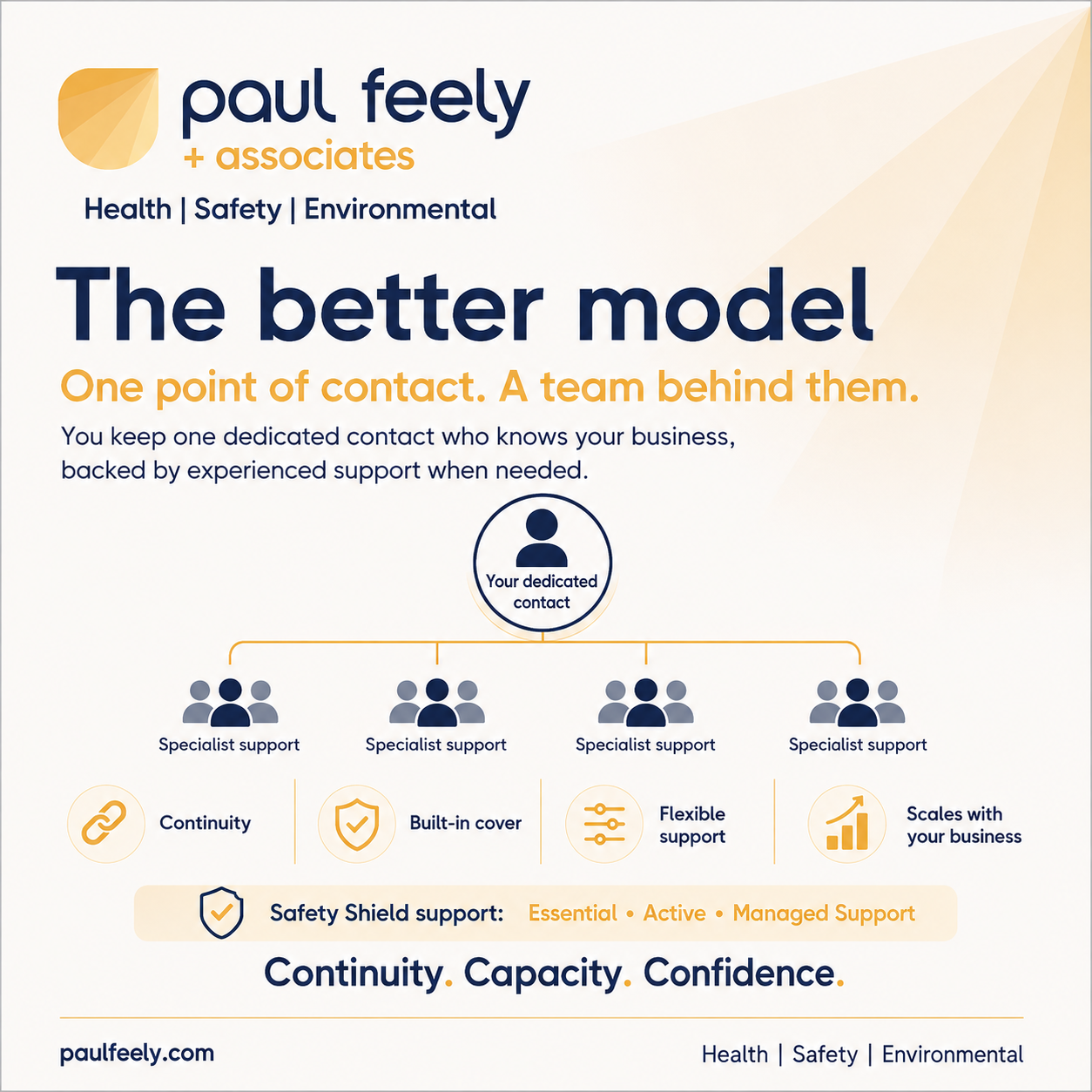
The answer is not to hire two of everything. It is to make sure the knowledge and the workload sit with more than one person. That is the model we work to: one dedicated point of contact who learns your business, backed by an experienced team who can step in when needed. You get a person who knows your sites and your priorities, and capacity behind them that does not disappear when they take leave.
One point of contact who knows you. A team behind them for everything else.
Growing Businesses Caught Between Too Much And Not Enough
There is a version of this that hits growing firms hardest.
The work is coming in, the headcount is climbing, and your health and safety responsibilities have grown with them. You are not yet at the point where a full-time safety manager makes sense on the books, but you are well past the point where compliance looks after itself.
So it lands on a director or an operations manager who is already flat out. Compliance gets done around the edges of the day job. Actions slip. Documentation drifts out of date. Health and safety becomes something the business reacts to when it goes wrong, rather than something it plans for.
The right support solves this without forcing a premature hire. You bring in experienced health and safety input at a level that matches where the business is now, and you scale it up as the workforce, the sites, and the project requirements grow. You get the cover you need without committing to a salary the business is not ready to carry.
The Cost Of Changing Systems Every Time Someone New Arrives
Health and safety professionals move roles often, because the opportunities are there. Businesses know this happens. Many are still not ready for what it costs them.
Every new safety professional brings their own preferred systems, their own paperwork, and their own idea of what good looks like. For a business that changes safety managers every couple of years, that means rebuilding the same documents over and over.
The knock-on effects are real:
Staff get confused about which process they are actually meant to follow.
Work that was perfectly sound gets torn up and replaced rather than improved.
Money and time go into rebuilding systems that did not need rebuilding.
Standards drift out of line across different sites or departments.
None of that makes the business safer. It just makes it busier. Our role is to provide stability and build on what already works, rather than introduce change for its own sake. Continuity is worth more than any single person's preferred template.
When Your Health And Safety Manager Is Good But Overwhelmed
Some businesses have the opposite problem. The safety manager knows their subject well, but there is one of them and the work never stops. Incidents, inspections, training, meetings, project demands, and the documentation that keeps arriving.
The day fills up with whatever is on fire. The strategic work, the improvements that would actually move things forward, never gets a look in.
That person usually does not need replacing. They need a hand for a few weeks or months. Someone to clear the backlog of overdue actions, get them ready for an audit or an accreditation, cover a major project, or take the inspections and risk assessments off their plate for a while so they can lift their head up.
This is support, not a takeover. The internal manager keeps their role and their authority. The extra capacity simply gives them the room to do the job properly.
The Worry Nobody Says Out Loud
Underneath all of this sits the concern we hear most often, usually said quietly.
Bring in an outside consultant and they will find a hundred problems you did not know you had, hand you a folder of new procedures, and leave you with more admin than you started with.
It is a fair worry, and it is earned. Compliance that only exists on paper helps nobody. A risk assessment nobody reads protects nobody. If all an outside pair of hands does is generate paperwork to prove it was there, that is a cost with nothing behind it.
We work the other way round. We start with what you already have and build on it. We prioritise by the actual risk in front of us, not the size of the report. Wherever a process can be simpler, we make it simpler. The aim is a business that is safer and easier to run, one where people can follow what is being asked of them, rather than a business that only looks compliant on the day the auditor turns up.
What Good Health And Safety Support Looks Like
Strip it back, and every one of the situations above comes down to the same two needs. The consistency of someone who knows the business and how it runs, and the reassurance that they are not the only line of defence.
That is how we set it up:
One dedicated point of contact. One person who learns your business, turns up, knows your sites and your priorities, and picks up where things were left.
An experienced team behind them.The work does not stop when your contact takes leave, and you can call on specialist knowledge when something unusual lands on your desk.
Support that scales. You dial the level up during a big project or a busy period, and back down when things settle. You pay for the cover you need, not a fixed headcount.
Continuity is the thread running through all three. Whoever is in the room on any given day, the business keeps the same understanding of its sites, its priorities, and its open actions.
Safety Shield: Support That Matches Where You Are
We deliver this through Safety Shield, our health and safety support packages. They come in three levels ,Essential, Active, and Managed Support, so the level of input matches where the business is now and moves with it over time.
The point of three levels is that businesses are not all in the same place, and no single business stays in one place. A firm might start on a lighter level of support, step up to a higher one during a period of growth or a demanding project, and settle back down once things stabilise. The relationship, the point of contact, and the knowledge of your business stay the same throughout. Only the level of input changes.
That is what makes the same model work for very different needs:
Interim cover while you recruit a permanent replacement, so nothing drifts during the gap.
Ongoing support for a business that wants health and safety owned properly for the long term without carrying a full-time salary.
Extra capacity for a capable internal manager who is carrying too much and needs a hand for a defined stretch.
The right level depends on your sites, your sector, and how much you already have in place. The Safety Shield packages page sets out what each level includes.
Why Ongoing Support Is The Stronger Long-Term Option
When a safety manager leaves, the instinct is often to reach for a like-for-like replacement, or to call a consultant for a one-off fix. Both have a place. Neither, on its own, solves the underlying problem, which is that the whole function has been resting on one person.
A one-off consultant delivers a piece of work and moves on. You get the report, but not the continuity, and six months later there is nobody who still knows your business. A single internal hire rebuilds the same single point of failure you just felt the cost of, at full salary, with a recruitment process in front of it. Doing it around the day job means it keeps slipping until something forces the issue.
Our support packages answer all three. You keep a named contact who knows your business over time, you keep a team behind them so a single absence changes nothing, and you keep the ability to move the level of support up and down as the business does. For most firms, that combination of continuity and flexibility is the stronger long-term position, whether the immediate trigger is a resignation, a growth spurt, or an overloaded manager.
A Clearer Picture Of Where You Stand
If one name came to mind while reading this, the person who would leave a hole if they went, that is worth a conversation. Nothing has to be going wrong for you to want a clearer picture of where your health and safety function actually sits.
Get in touch to talk through the right level of support for your business, or read more about the Safety Shield packages. If you are not sure which level you need, our free two-minute level finder will suggest one without the need to commit to a consultation call.
Frequently Asked Questions
-
Interim health and safety support gives a business experienced health and safety cover for a defined period, usually while it recruits, manages a project, or handles a busy spell. You get a qualified point of contact who owns your compliance without the commitment of a permanent hire.
-
Safety Shield is our health and safety support, offered as packages in three levels: Essential, Active, and Managed Support. The levels range from lighter-touch support up to fully managed cover, so the input matches where your business is. You keep the same contact and continuity as your needs change.
-
Yes. You can move between levels of support as the business changes, stepping up for a major project or a busy period and back down once things settle. The point of contact and the knowledge of your business stay constant while the level of input flexes.
-
Not unless that is what you want. Where a business already has a capable internal manager, our role is to add capacity, not take over. We clear backlogs, cover projects, and handle peaks so the internal manager can focus on higher-value work and keep their authority.
-
No. It suits three situations: holding continuity while you recruit, giving a growing business cover before a full-time hire is justified, and supporting an internal manager who is overloaded.
-
A one-off consultant typically delivers a piece of work and leaves. A support package is an ongoing relationship with a named contact who learns your business over time and stays accountable for it, backed by a team rather than a single individual.
-
Yes. We operate under all three regulatory frameworks, with offices in Newry, Dublin, and Birmingham, and we apply the correct legislation and terminology for wherever your sites are.