

Outsourced Health & Safety: Why Flexible Expertise Can Beat a Full-Time Hire
Overview
Outsourced health and safety means appointing an external consultancy to run all or part of your health and safety function instead of employing someone in-house. It gives your business competent, accountable advice that scales with your risk and workload, and for many businesses it costs less than employing someone full-time. The legal duty to manage health and safety stays with you as the employer.
Outsourcing health and safety gets misread in two directions. Some business owners hear it as a way to hand the problem to somebody else. Others hear it as a budget version of an in-house health and safety manager. Both readings sell it short.
What you actually get is competent judgement at the level your business needs, when it needs it. Some months that means site inspections and detailed review. Other months it means a phone call and a second opinion. The legal duty to manage health and safety stays with you as the employer the whole way through, and good external support helps you carry that duty properly, with clearer sight of your risks and more confidence in the decisions you make.
Who Is Legally Responsible When You Outsource
Health and safety law across the UK and Ireland is built on the idea of competent assistance. In Great Britain, Regulation 7 of the Management of Health and Safety at Work Regulations 1999 requires every employer to appoint one or more competent persons to help meet their legal duties. Northern Ireland sets out the same requirement in its own 2000 Regulations, and in the Republic of Ireland, Section 18 of the Safety, Health and Welfare at Work Act 2005 does the equivalent job.
The law does not require that competent person to sit on your payroll. Many businesses meet the duty by appointing an external competent person, and that is what outsourced health and safety support provides in practice. That appointment is a named, documented one you can produce for an inspector, an insurer, or a client running procurement checks.
What the law never lets you hand over is accountability. Appointing a consultant does not transfer the employer’s duty. Your business still owns the decisions, and it still owns what happens on site each day. That is the reason the quality of the support matters so much. A good adviser helps directors and managers understand their obligations and put workable controls in place. An adviser worth paying for is never just a name on a policy document.
Why Judgement Matters More Than Paperwork
Plenty of businesses still picture health and safety support as folders of documents: policies, risk assessments, method statements, training records. Those things matter, and clients and insurers will ask to see them, but on their own they protect nobody. A risk assessment gathering dust in a drawer has never stopped an accident.
The support earns its keep when the focus moves from documents to decisions. Which risks genuinely matter in your operation? Which controls will hold up on a wet Tuesday in February when the regular supervisor is off? Good advice answers questions like these in plain terms. It tells you where you are overcomplicating things, and just as plainly where your arrangements are too light. It should cut noise rather than add to it.
Outsourced Health and Safety vs a Full-Time Hire
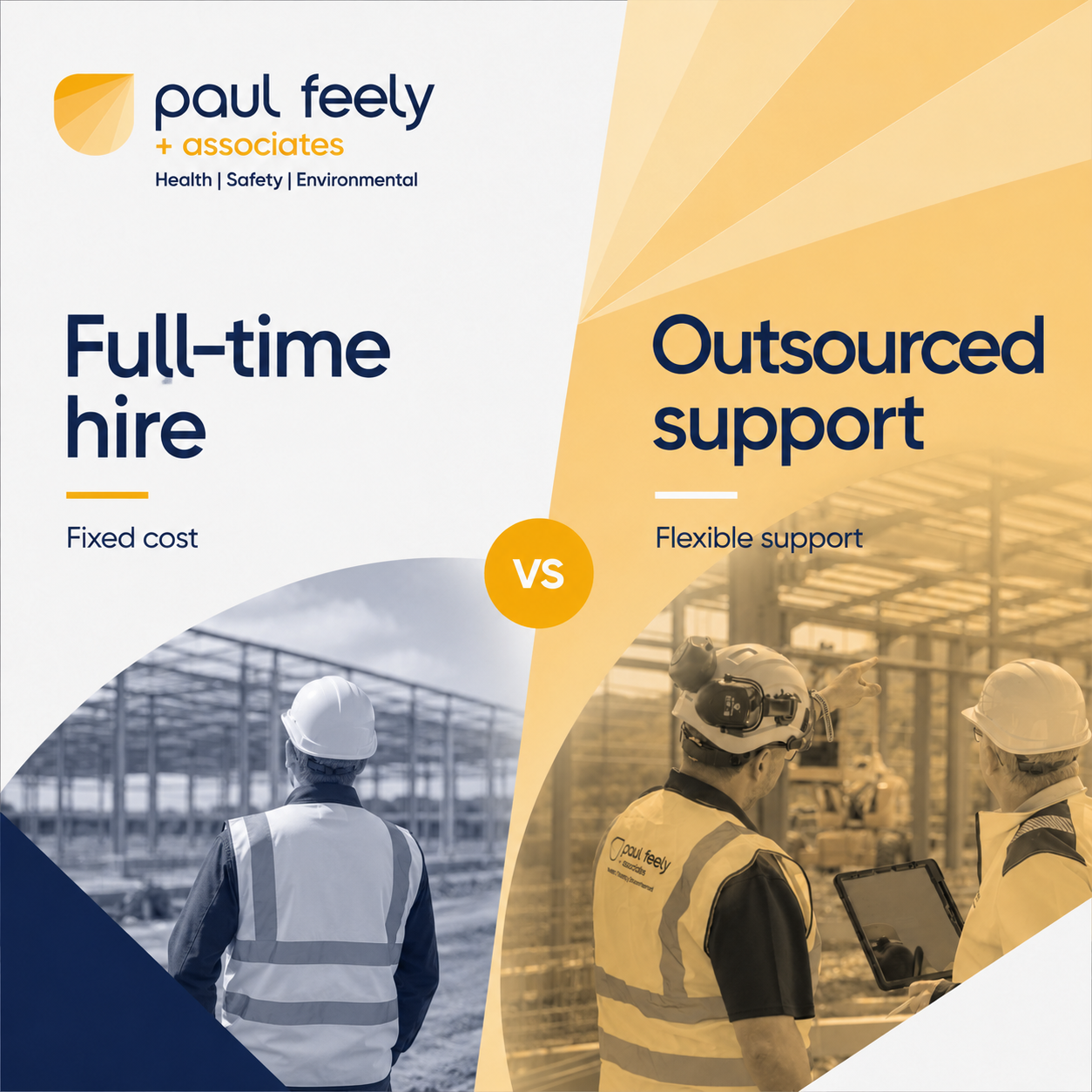
A full-time health and safety manager can be the right call for larger, higher-risk, or genuinely complex organisations. Many businesses sit somewhere different. Their duties are real, but the demand is uneven: busy during a project or an audit, quieter in between.
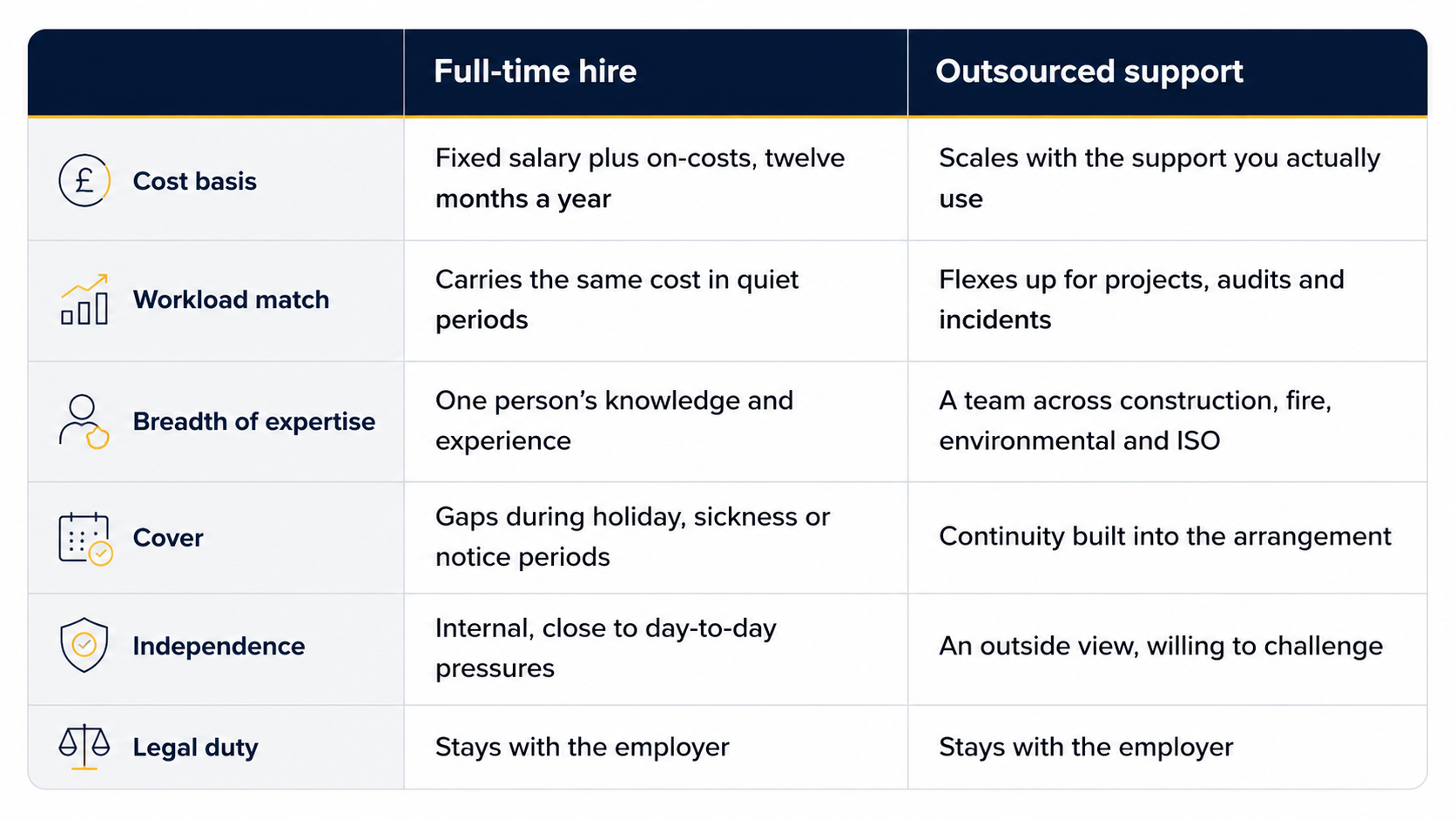
Hiring full time fixes your cost regardless of that workload. National salary benchmarking drawn from more than 3,600 reported UK roles in 2026 puts the average for a health and safety manager at around £46,000, with Greater London closer to £55,000. The headline salary is only the start. Employer National Insurance and pension contributions sit on top, then recruitment fees, training and CPD, software, equipment, holiday cover, and the management time the role absorbs. The true annual cost of the hire lands well above the figure in the job advert.
None of this makes outsourcing automatically cheaper. The stronger argument is fit. If your business needs senior judgement for part of the year and lighter oversight for the rest, paying for a permanent role twelve months a year spends budget poorly. An outsourced arrangement can scale up during a project, a tender, an audit, or an incident, then settle back down once the pressure passes.
Why Judgement Matters More Than Paperwork
Plenty of businesses still picture health and safety support as folders of documents: policies, risk assessments, method statements, training records. Those things matter, and clients and insurers will ask to see them, but on their own they protect nobody. A risk assessment gathering dust in a drawer has never stopped an accident.
The support earns its keep when the focus moves from documents to decisions. Which risks genuinely matter in your operation? Which controls will hold up on a wet Tuesday in February when the regular supervisor is off? Good advice answers questions like these in plain terms. It tells you where you are overcomplicating things, and just as plainly where your arrangements are too light. It should cut noise rather than add to it.
This matters most for growing businesses. They have moved past the point where the occasional document update is enough, but they cannot yet justify an internal department. Retained support bridges that gap with a steady rhythm of reviews and site visits, and competent advice available in between.
What Good Outsourced Support Includes
Outsourced support varies a lot in quality, and the brochure rarely tells you which kind you are buying. At its core, a strong arrangement gives you a named adviser who actually knows your operation and a scheduled rhythm of reviews and site visits, with someone competent on the end of the phone when something unexpected lands.
That last point matters more than it looks. When an incident happens or an inspector calls, the value of outsourced support is having an experienced person you can reach the same day, someone who already knows your sites, rather than a number you have never used. Around that core sit the practical jobs: keeping risk assessments and policies honest, supporting accident investigations, helping with tenders and accreditations, and coaching the managers who carry safety responsibility day to day.
How much of the function you hand over is your choice. Some businesses outsource the lot, so the consultancy effectively becomes their health and safety department. Others keep an internal lead, often an operations or office manager, and bring in external expertise for the competent person appointment, independent audits, and specialist advice. Both work. The defining feature is the same either way: qualified external expertise that is genuinely accountable for the advice it gives.
Because the outsourcing market is unregulated, it is worth checking a few things before you commit. Make sure the named person who will actually work with you is suitably qualified, that the provider carries professional indemnity insurance, that you get a consistent consultant rather than a rotating team, and that the scope and the fee are clear about what is and is not included.
Good support ties the work back to the decisions managers actually make, and that is what separates it from a subscription to paperwork. Actions are given an owner and a deadline. Reports get read and acted on, not filed. Managers, in turn, can see for themselves whether a control is holding up on site.
The most useful test of any arrangement is what it does to your own managers. If only the consultant understands the system, the system is not embedded, and the business is renting competence rather than building it. Good support strengthens the people inside the business while supplying the expertise it cannot yet justify employing.
Why An Outside View Catches What Familiarity Hides
Internal knowledge counts for a lot, and nobody understands a business like the people who run it. The trouble is that familiarity breeds blind spots. A shortcut that has never gone wrong starts to look like the proper method, and a hazard that has sat in place for years stops registering at all.
An external adviser sees your sites without that filter and brings comparisons from other sectors along with them. That independence is worth a great deal when a leadership team wants an honest answer about where the real gaps are. A consultant who agrees with everything is not earning the fee. Practical, commercial advice should still call out a weak arrangement when it finds one.
When Outsourcing Makes Sense
The pattern we see most often is a business that has grown past its informal arrangements. The work has become more complex, often across several sites, and clients or accreditation bodies have started asking harder questions. Managers are carrying safety responsibilities on top of their actual jobs, usually without much guidance. Nobody doubts that the business cares about safety. The real question is whether the current support model still matches the level of risk the business carries.
Outsourcing also suits defined periods of pressure. A move to new premises, a client audit, an unusually high-risk project, a spell of rapid recruitment, or the aftermath of an incident can each justify specialist input for a season without committing to a permanent role.
Choosing The Right Level Of Support
There is no single correct package, which is why a one-size retainer should make you wary. The starting point is an honest look at what is already in place and where it has worn thin. Which assessments are current, which have gone out of date, and where do your managers feel least sure of their footing? From there, support can be built around real need, whether that is light-touch oversight, a retained arrangement with periodic visits, or frequent site presence for a higher-risk operation.
Common concerns about outsourcing
Will an outside adviser really understand how we work?
A good arrangement starts by learning how your operation runs rather than arriving with a template. With a named consultant who stays with you, that knowledge builds over time, and an experienced adviser also brings patterns from other sites in your sector that an internal hire may never have seen. The worry is a fair test of a provider rather than a fault in the model.
Does outsourcing mean handing over control of our safety?
No. You delegate the work of managing health and safety, not the responsibility or the decisions. Good support keeps your leadership informed with clear reporting and a consultant who talks to you, so you keep control and gain expertise you did not have before.
If the legal duty stays with us anyway, what is the point?
That is exactly why competent support matters. The duty cannot be passed on, so the real question is whether you can meet it well on your own. For most businesses the honest answer is not yet, and a qualified adviser is what makes meeting the duty realistic rather than a box you hope is ticked.
Is outsourcing only for small businesses?
It suits businesses without a full in-house department particularly well, but it is not limited to them. Larger organisations often keep an internal lead and bring in outside expertise for audits and specialist advice. The level of support flexes with the size and risk of the business.
Is Outsourcing The Right Fit For Your Business?
The honest summary is that outsourced health and safety is its own model rather than a watered-down version of an in-house manager, and for many businesses it fits better: expertise that stays close enough to understand the operation and independent enough to challenge it.
If you are weighing up whether your current arrangements still match the risk your business carries, that is exactly the question our Gap Analysis is built to answer. Our packages page sets out how our ongoing support works, and you can read more about our health and safety consultancy services. If you would rather start smaller, our health and safety scorecard gives you a quick read on where you stand in a few minutes. Or get in touch and we will talk it through.