
20 Things Need Improved. Where Would I Actually Start?
I think there are a lot of businesses in this position. They know their health and safety needs improved, there might be 20+ things sitting on the list, and everybody agrees something needs done. The difficulty is working out where to start.
Some risk assessments need looked at. Training records aren't where they should be. There are actions sitting from previous audits, the plant register needs sorted, or there are issues on site that people have known about for a while. The problem isn't always that nobody cares. Sometimes there's simply that much to do that people become a wee bit overwhelmed by it.
They don't know what should come first, they don't know who should be responsible for what, and everybody is already busy with the day-to-day running of the business. Before you know it, another month has gone by and the same things are still sitting there. That's when businesses can start burying their head in the sand a bit.
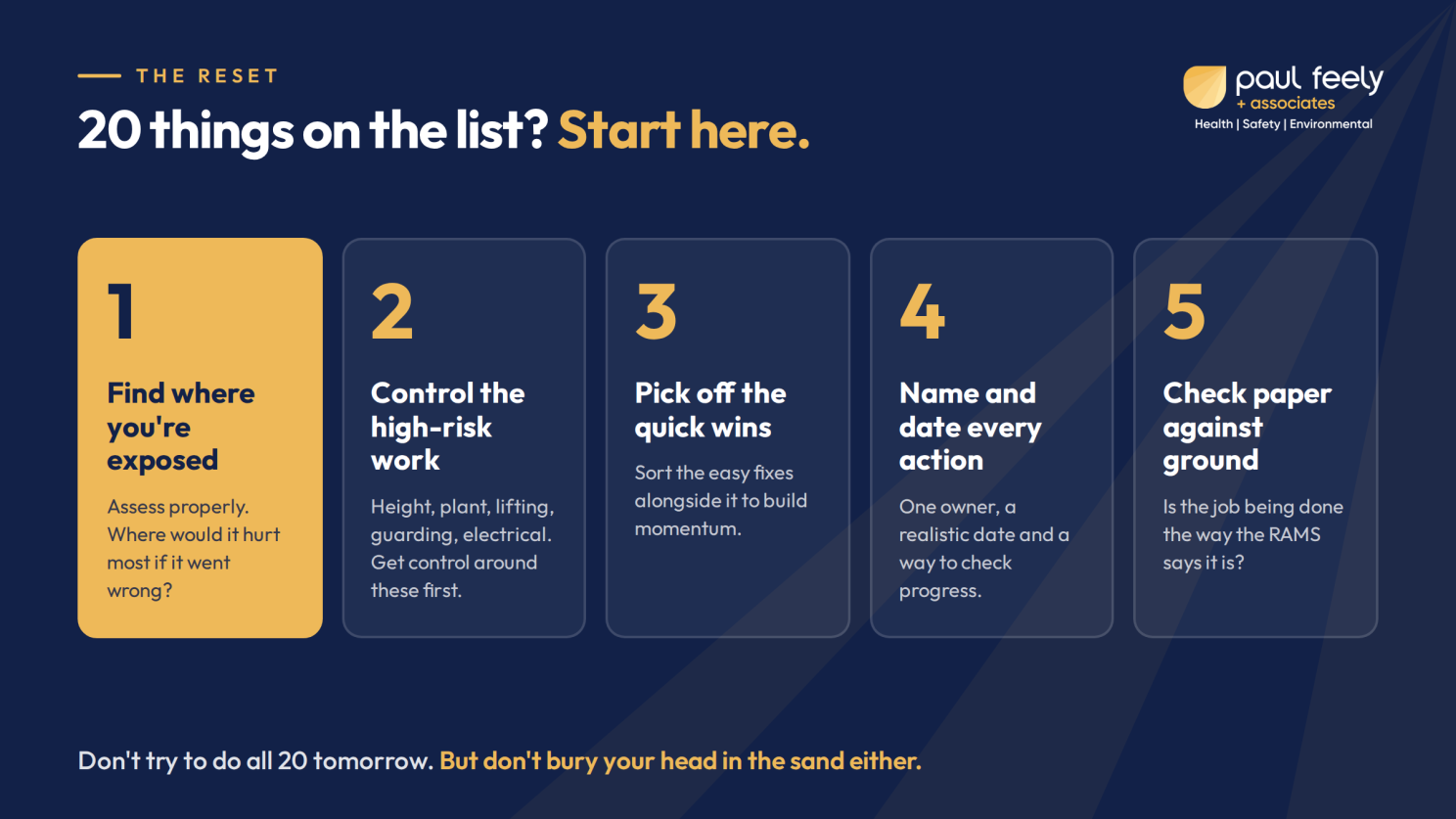
If I walked into that business tomorrow morning, I wouldn't try to fix all 20 things at once. I'd start by understanding where the biggest risk actually is.
Start With The High-Risk Areas
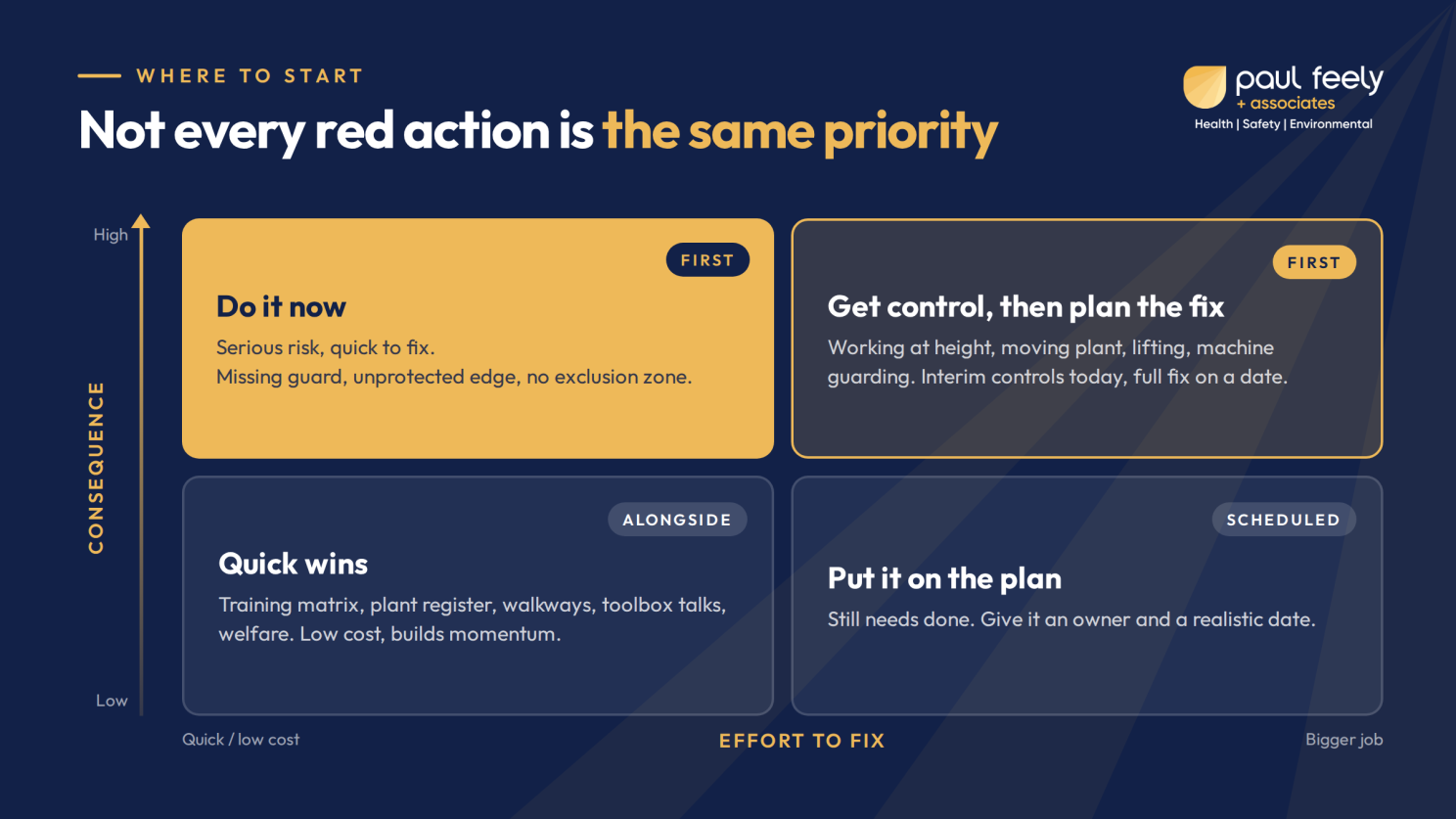
The first thing I'd want to understand is what the high-risk activities are in that particular business. It might be working at height, machine guarding, people working around moving plant, lifting operations, electrical work or something completely different depending on the work they do.
You need to assess the business properly first and understand where you're most exposed. You could have an out-of-date training matrix sitting on the same action list as a serious issue with machine guarding. Both need dealt with, but they're not necessarily the same priority.
That's an important distinction, because when everything becomes another red action on a spreadsheet, after a while all the red starts to look the same. It isn't. I'd look first at the activities that could have the biggest consequence if something goes wrong and make sure we're getting control around those.
Pick Off The Low-Hanging Fruit Alongside It
Once you've started looking at the higher-risk areas, there are nearly always other things sitting there that can be sorted relatively easily. The training matrix might need brought up to date, or the business might not have one at all. The plant and equipment register might be incomplete. Pedestrian walkways might need improved. Toolbox talks might have stopped happening, welfare might need looked at, or inspection arrangements might be inconsistent.
A lot of this doesn't cost a fortune. Some of it costs very little. The issue is that these things can sit on an action list for months because nobody has pulled everything together and asked a fairly simple question: what can we actually sort here quickly?
Getting some of those things moving matters because it starts to create a bit of momentum. You're no longer looking at a massive list thinking everything has to be fixed tomorrow. You can start to see a plan taking shape.
Give Every Action A Name And A Date
We always say health and safety is everybody's responsibility, and ultimately it is. But when there is a specific action that needs completed, somebody needs to be responsible for it. Put a name beside it e.g. Paul, can you look after this? Gareth, you take that one. This needs to be done before the end of November.
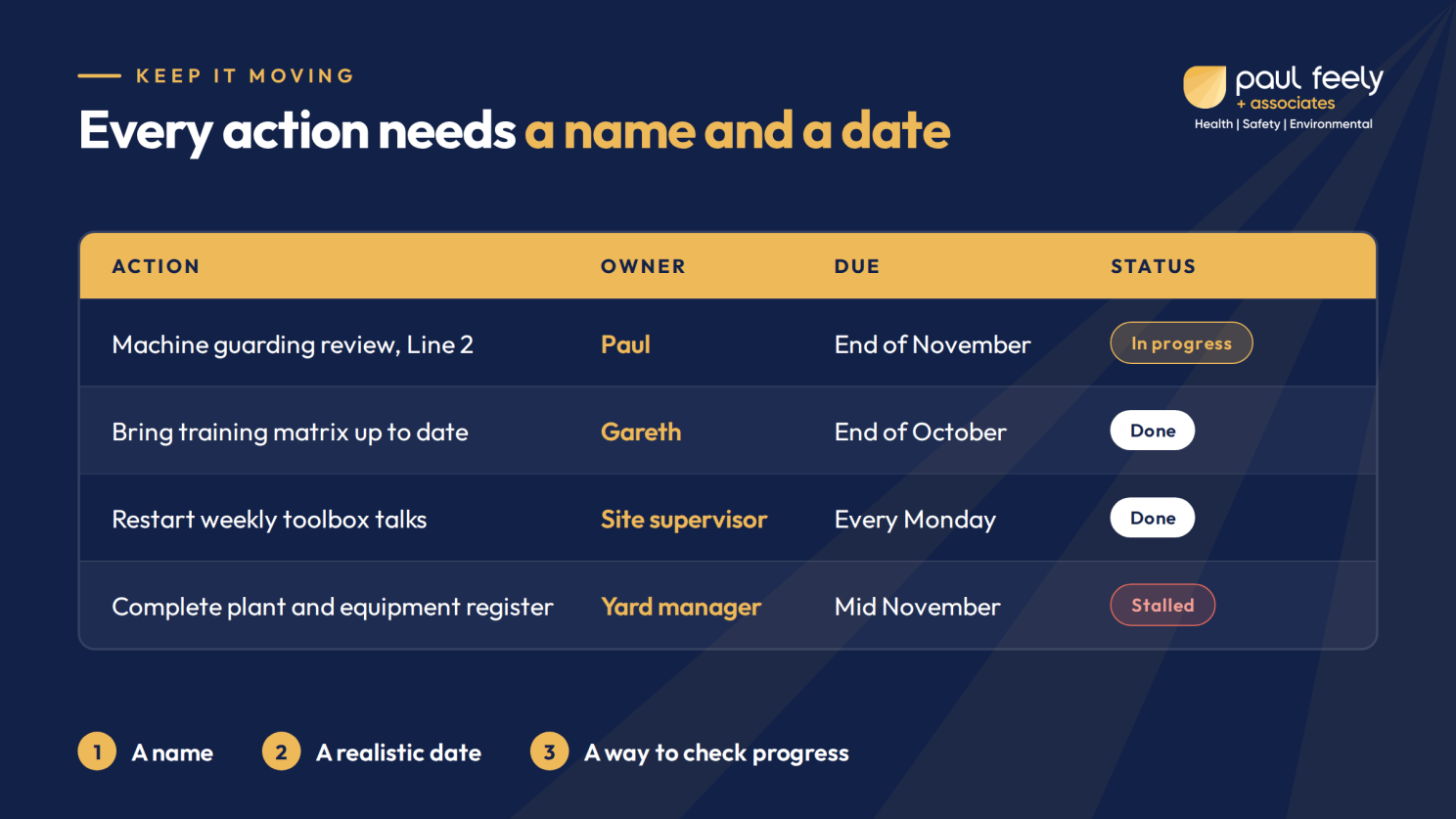
That isn't about trying to get people into trouble. It's about working together and putting a bit of accountability around what has been agreed. In my experience, putting the action plan together isn't normally the difficult part. Keeping it moving is.
A business has the meeting, everybody agrees what needs done, the actions are written down and everyone goes back to work. Then the day-to-day pressures take over. Three months later somebody opens the spreadsheet and half the same things are still sitting there because they've fallen off the radar.
That's why I like having a clear person against every action, a realistic date and some way of checking progress. It doesn't need to be complicated, but there needs to be enough accountability to make sure things continue to move.
Business Owners Need Visibility, Not Another Job
This is something I think we don't talk about enough. The business owner or MD doesn't need to personally manage every training record, inspection, risk assessment and action. They've already got a business to run. What they do need is visibility.
They need to know where the main risks are, what is being done about them, who's responsible, what has already been completed and where something has started to stall. How the business provides that visibility can be quite simple. It might be a regular meeting, a shared action tracker, a WhatsApp group or whatever works for that particular company.
I've seen the difference this makes. There's a point where you can nearly see an owner start to settle. Not because every issue has suddenly disappeared. Usually there is still plenty to do. The difference is that they can now say, 'Right, we know what the issues are, we've got a plan in place, people are responsible for it and I can see that things are actually moving.'
That's a much better position than simply knowing in your gut something isn't right and hoping nothing happens. Leadership still has to drive it. If you're running the business, people need to see that you're interested in health and safety. Walk the floor, get onto site, ask questions and check in on things. You don't need to personally do everybody's job for them, but if the leaders aren't seen to care about it, it's very difficult to expect everybody else to.
Take The RAMS Out Onto The Ground
Once we've identified the higher-risk activities, this is another area I'd look at closely. What's actually in the risk assessment? What's in the RAMS? What's in the SOP? First of all, is there something suitable there covering the work? Then there's another question which, in many ways, is even more important: is that actually how the job is being done?
There is no point having a method statement saying, "This is how we carry out this job, these are the steps and these are the controls," if I can walk onto site and watch people doing something completely different. A lot of businesses think that because everybody has signed the risk assessment or the SOP, they're covered. They're not.
If your own procedure says the work should be carried out one way and the business isn't actually following it, there are going to be questions if something serious happens. Why weren't the controls being followed? Was anybody checking? Was the work properly supervised? Was the procedure realistic in the first place? Had the way the job was being done changed over time without anybody updating the documentation?
Signing the piece of paper isn't the end of it. You have to get onto the ground and see what is actually happening. That's where supervision, inspections and managers being visible around the work become important.
Most Businesses Already Know When Something Isn't Right
This is another thing I've noticed over the years. Quite often the owner already knows. They've got that sixth sense that something isn't quite right. There might have been a few accidents or incidents. A client might have started asking harder questions. The same issues might keep appearing during inspections, or health and safety has simply become a headache because nobody really feels in control of it.
They know it isn't where it needs to be, but the business keeps moving and other things keep taking priority. The problem is that the cost of leaving these things unresolved isn't just another outstanding action on a spreadsheet.
At the serious end, it's somebody being badly injured or killed. Then you've potentially got the regulator involved, claims, insurance companies, lost time, clients losing confidence and senior management spending huge amounts of time dealing with the aftermath. That's why I believe in dealing with these things before something forces the conversation.
You don't need to make the business perfect overnight. You need to take a reset, understand where you're exposed, prioritise the higher-risk areas and start getting some of the straightforward things moving alongside them. Then put names and dates against the actions, give management visibility and keep checking that what you said should happen on paper is actually happening on the ground.
Need Support Getting It Under Control?
If you know there are issues in the business but you're not sure what needs dealt with first, we can help you get a clear picture of where you're exposed and what needs to happen next.
That might mean a health and safety compliance review of your highest-risk activities, looking at whether your RAMS and procedures match what is actually happening on the ground, helping you build a practical action plan, or ongoing support to keep actions moving and give management better visibility.
The aim isn't to create more paperwork. It's to help you understand what matters most, put the right controls in place and make sure the plan doesn't fall off the radar.
If you'd like to talk through where your business currently stands, get in touch.
ROI: +353 (0) 85 217 0034
UK: +44 (0) 28 3005 0365
Email: safety@paulfeely.com
Frequently Asked Questions
-
Start with the high-risk activities, the ones that could seriously injure or kill someone if something goes wrong, such as working at height, machine guarding, moving plant or lifting operations. Get control around those first, then sort the quick, low-cost actions alongside them to build momentum.
-
No. A signature shows the business knew how the job should be done. If the work on site is being done differently, there will be questions after an incident about supervision, checking and whether the procedure was realistic. You need to check the work on the ground matches the paperwork.
-
No, but they need visibility. The owner should know where the main risks are, what is being done, who is responsible and where actions have stalled. They also need to be seen to care, by walking the floor and asking questions.